
You are spending $3,000, $5,000, or even $8,000 every month on dental marketing and yet when someone asks you exactly how many new patients came from your last campaign, you cannot give a confident answer. You have a vague sense that things are working, but you have no clear data to back it up. This is one of the most common and costly situations dental practice owners find themselves in, and it is entirely avoidable. A skilled dentist marketing agency does not just run campaigns and hope for the best. It builds transparent, data-driven measurement systems that connect every marketing dollar spent to a measurable patient outcome. In 2026, understanding how ROI and performance are tracked is not just important for accountability; it is the difference between a marketing investment that grows your practice and one that quietly drains your budget month after month.
What Does ROI Actually Mean for a Dental Marketing Agency?
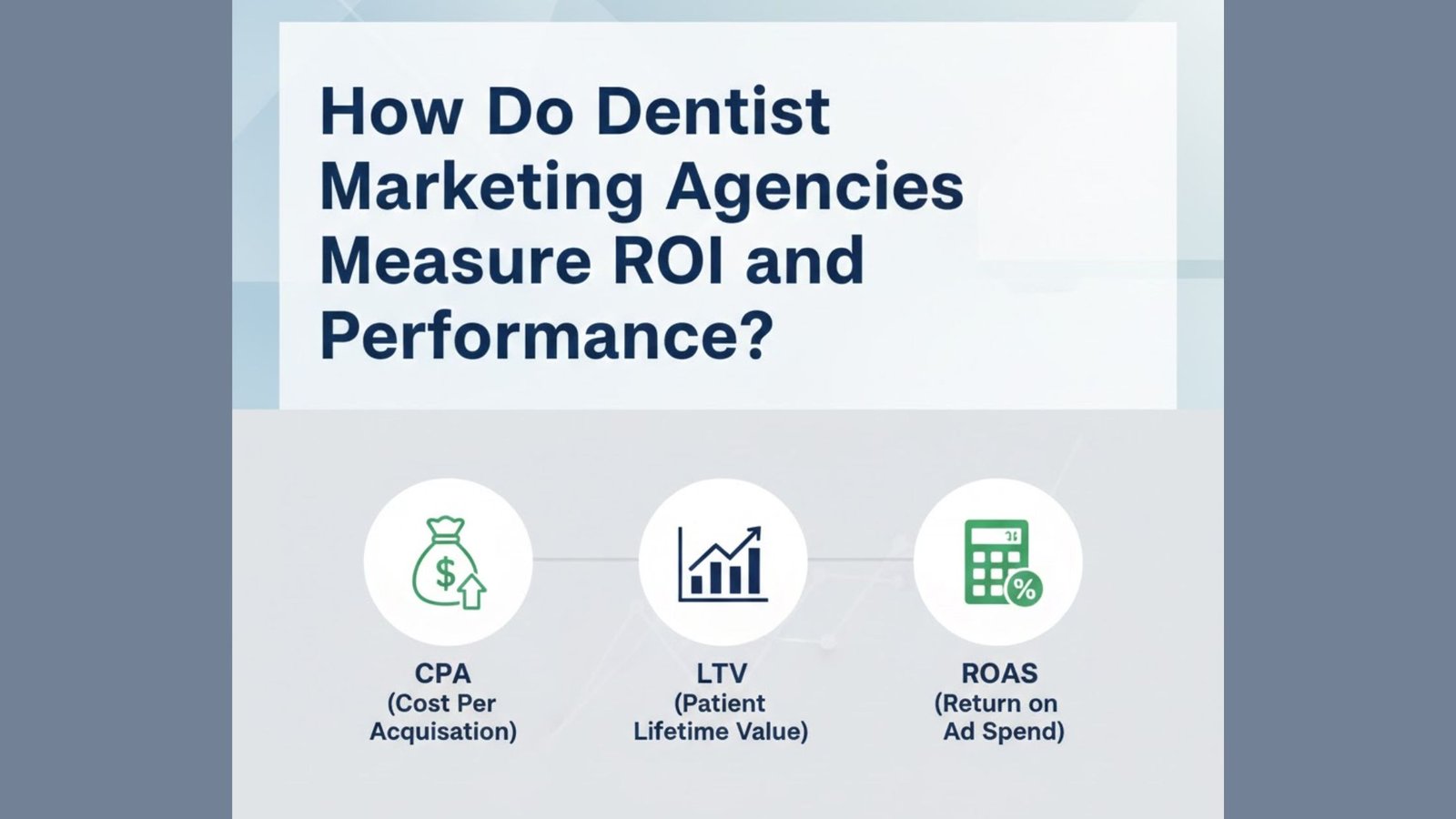
A dentist marketing agency that takes measurement seriously defines ROI in very specific, practice-relevant terms rather than broad digital marketing language. Return on investment in the dental context answers one fundamental question: for every dollar spent on marketing, how many dollars are generated in patient revenue? The most widely used formula is straightforward: ROI equals the revenue generated from marketing minus the total marketing cost, divided by the marketing cost, then multiplied by 100 to produce a percentage. So if a practice spends $3,000 on a Google Ads campaign and those ads generate $12,000 in patient revenue, the ROI is 300%, meaning every dollar spent returns three dollars in production.
The American Dental Association and leading dental marketing benchmarking surveys generally define a healthy marketing ROI as falling between 300% and 500%, or a 3:1 to 5:1 return ratio. Below a 3:1 return, a campaign typically needs optimization or budget reallocation. Above 5:1, the strategy is performing at an elite level, often driven by mature local SEO campaigns or a well-optimized referral system that supplements paid channels. Understanding where your current marketing sits against these benchmarks is the starting point for any meaningful conversation about performance. An agency that cannot tell you your current ROI ratio with confidence is an agency that is not measuring well enough to improve.
Why Dental Marketing ROI Metrics Go Beyond Simple Revenue Numbers
Dental marketing ROI metrics are far more nuanced than a single revenue calculation suggests. Revenue alone does not tell the full story because not all patients carry equal long-term value to the practice. A patient who comes in for a $99 new patient special and never returns contributes very little to practice growth, while a patient who accepts a comprehensive treatment plan, refers two family members, and stays active for six years represents an entirely different level of value. This is where the concept of patient lifetime value, often abbreviated as LTV, becomes one of the most important numbers a dental practice can track in relation to its marketing spend.
The average LTV of a general dentistry patient in the United States typically ranges between $4,000 and $10,400 depending on the practice, the market, and patient retention rates. For specialty procedures like dental implants, Invisalign, or full cosmetic cases, the LTV per patient can extend significantly higher. When a dental marketing agency calculates ROI using LTV rather than just first-visit revenue, the return figures often look dramatically different. A campaign that appears to be generating a 3:1 return based on initial appointment revenue may actually be generating a 20:1 or 30:1 return when the full lifetime relationship with those new patients is factored into the equation. Agencies that present LTV-based ROI give practice owners a far more accurate picture of the true return on their marketing investment.
How Tracking Results from Dental Campaigns Is Done Correctly
Tracking results from dental campaigns requires layering multiple data sources together rather than relying on any single tool in isolation. The baseline measurement stack used by most competent dental marketing agencies includes Google Analytics for website behavior and traffic sourcing, Google Search Console for organic search performance and keyword visibility, and a call tracking platform such as CallRail for attributing phone inquiries to specific campaigns and channels. Without at minimum these three tools configured and reporting correctly, a dental practice is essentially operating on guesswork regardless of how much is being spent on marketing.
Call tracking deserves particular attention because phone calls remain the primary conversion method for dental patient inquiries. The way it works is simple but powerful: each marketing channel is assigned its own unique tracking phone number. Google Ads gets one number, the website homepage gets another, direct mail pieces get a third, and so on. When a patient calls any of those numbers, the system instantly identifies which channel drove that call, how long the call lasted, and whether the call resulted in an appointment booking. Over time, this data reveals which channels are generating actual patient conversations versus those generating clicks and visits that never convert into calls. A dental marketing agency that does not use call tracking for its clients cannot fully prove which campaigns are working.
Integrating Practice Management Software for Complete Attribution
The most advanced dental marketing ROI tracking goes one step further by integrating marketing data directly with practice management software platforms like Dentrix, Eaglesoft, or Open Dental. When these systems are connected to marketing analytics, it becomes possible to track a patient’s entire journey from their first online touchpoint, whether that was a Google search, a Facebook ad, or a review on Healthgrades, all the way through to their completed treatment and the associated production revenue. This level of attribution gives the practice owner undeniable clarity on which marketing channels are producing the highest-value patients, not just the most patients. Training the front desk team to ask every new patient “how did you hear about us?” and recording that answer consistently in the patient management system adds a valuable manual data layer that strengthens the accuracy of all automated tracking.
The Key Performance Indicators That Define Campaign Success
Analytics for dental marketing should be built around a specific set of key performance indicators (KPIs) that connect marketing activity to practice growth. While there are dozens of data points available across digital marketing tools, the most meaningful ones for a dental practice fall into a manageable framework that any practice owner can monitor and understand without needing a marketing degree.
The most critical dental marketing KPIs include new patient inquiries generated by channel, patient acquisition cost (PAC) which is the total marketing spend divided by the number of new patients acquired, website conversion rate which measures what percentage of visitors complete a booking or contact form, organic search ranking positions for priority service keywords, Google Business Profile engagement metrics including calls and direction requests, and review volume growth month over month. These indicators, reviewed consistently and compared against prior periods, tell the full story of whether a marketing program is building momentum or losing ground.
If you want to understand how your current marketing program stacks up against these performance benchmarks for your specific market and practice type, contact us to get a clear, honest assessment of where your gaps are and what it would take to close them.
Patient Acquisition Cost: The Single Most Actionable Metric
Patient acquisition cost, or PAC, is the single most actionable metric in dental marketing performance measurement because it connects spending directly to outcomes in the clearest possible way. The calculation is simple: divide the total marketing spend for a given period by the number of new patients acquired through marketing during that same period. If a practice spends $4,500 in a month and acquires 20 new patients as a result, the PAC is $225 per patient. Whether that number represents a good investment depends entirely on the types of procedures those patients accept and their expected lifetime value to the practice.
Industry benchmarks for dental patient acquisition cost in 2026 show that general dentistry practices acquiring new patients through paid digital channels typically see a PAC ranging from $150 to $300. Practices focused on high-value specialty procedures like implants or cosmetic dentistry may see PAC figures between $250 and $500 per patient, but those figures need to be evaluated against the production value of the cases being generated. A $400 PAC for a patient who accepts a $12,000 full-mouth restoration case represents exceptional ROI. The same $400 PAC for a patient who comes in for a cleaning and never returns is a very different conversation. This is precisely why PAC should never be evaluated in isolation without reference to the case mix and LTV of the patients being acquired.
How Analytics for Dental Marketing Reveal What Is Actually Working
Analytics for dental marketing serve one primary purpose: eliminating guesswork about where to invest the practice’s marketing resources. In a practice spending $5,000 per month on marketing across four or five channels, knowing with certainty that two of those channels are generating 80% of the new patient inquiries while two others are producing almost none is information worth thousands of dollars in budget optimization. Yet according to a Dental Economics survey cited frequently in the dental marketing industry, over 50% of dental practices do not reliably monitor or evaluate their marketing results, and only 3% use call tracking software. This means the majority of practices are making budget decisions based on impressions rather than evidence.
A competent dental marketing agency will configure a unified reporting dashboard that pulls data from all active channels into one view, updated in real time or on a weekly basis. This dashboard typically shows organic search traffic and ranking trends from Google Search Console, paid search performance including click-through rate, cost per click, and conversion data from Google Ads, call volume and source attribution from CallRail or a similar platform, Google Business Profile metrics including search impressions, calls, and website click-throughs, and review growth across Google, Yelp, Healthgrades, and Facebook. When all of this data is visible in one place, patterns become clear quickly. Channels that are delivering cost-efficient patient inquiries can be scaled. Channels that are consuming budget without producing measurable results can be paused or restructured. This is how data-driven agencies improve performance over time rather than simply continuing to bill for activities without evidence of impact.
ROI Benchmarks by Marketing Channel: What to Expect
Different dental marketing channels produce different returns on investment, and understanding the expected performance profile of each one helps practice owners set realistic expectations and allocate their budget more strategically.
| Marketing Channel | Typical Time to Results | Avg. Patient Acquisition Cost | ROI Profile |
| Local SEO and Google Business Profile | 3 to 6 months | Under $50 per patient (mature) | Highest long-term ROI |
| Google Ads (PPC) | 24 to 72 hours | $150 to $300 per patient | Strong, requires active management |
| Local Services Ads (LSAs) | 48 hours | $80 to $200 per patient | High for local intent queries |
| Content Marketing and Blogging | 6 to 18 months | Under $75 per patient (mature) | Compounds significantly over time |
| Reputation Management | 30 to 90 days | Low incremental cost | Very high conversion impact |
| Social Media Advertising | 1 to 4 weeks | $100 to $250 per patient | Moderate, strong for brand awareness |
| Email Marketing and Reactivation | Immediate | Very low per patient | Highest for existing patient base |
How to Evaluate Whether Your Dental Marketing Agency Is Being Transparent
Transparency in reporting is one of the clearest indicators of whether a dental marketing agency is genuinely accountable for the results it produces. An agency that delivers only vanity metrics like total impressions, social media reach, or website sessions without connecting those metrics to actual patient inquiries and appointment bookings is not giving you the information you need to make informed decisions. Honest performance reporting requires showing you both the numbers that look good and the numbers that need improvement, because no marketing program performs perfectly across every channel all the time.
A high-quality dental marketing agency will review performance data with you regularly, explain what the numbers mean in plain language, and recommend concrete changes when a channel is underperforming rather than simply continuing to bill for it. They will set campaign benchmarks before launching new initiatives so you have a clear basis for evaluating whether those initiatives succeeded. They will also show you how your performance compares to industry benchmarks so you have an objective frame of reference rather than just taking the agency’s word that your results are good. If your current agency cannot do these things consistently, that is important information about the quality of partnership you are receiving.
The Role of AI and Predictive Analytics in Dental Marketing Measurement
Dental marketing performance measurement in 2026 is increasingly being enhanced by artificial intelligence and predictive analytics tools that go beyond historical reporting to help practices anticipate future performance. AI-powered marketing platforms can now analyze patterns in patient inquiry data to predict which channels are likely to produce the highest returns in the coming months based on seasonal trends, competitive dynamics, and local market shifts. They can also identify patients who are at risk of lapsing in care and trigger personalized reactivation outreach before that patient churns out of the active patient base entirely.
On the search side, AI tools like Google’s AI Overviews, ChatGPT, and Perplexity are increasingly being used by patients to research dental services and find recommended practices in their area. Leading dental marketing agencies are now tracking their clients’ visibility within these AI-generated search results as a new performance metric, sometimes called Generative Engine Optimization (GEO) performance. Practices that consistently appear in AI-generated answers for dental queries in their market have a significant competitive advantage that compounds over time as AI-assisted search continues to grow in consumer adoption. Agencies that are not yet measuring or optimizing for this emerging channel are leaving a meaningful visibility gap unaddressed.
Once your agency is consistently tracking the right metrics, optimizing the right channels, and reporting with genuine transparency, your marketing investment stops feeling like a cost center and starts functioning like a growth engine with predictable outputs. Connecting with the team here is the most direct way to understand what proper measurement and accountable performance management could look like for your practice.
Frequently Asked Questions About Dental Marketing ROI and Performance
What is a good ROI for dental marketing campaigns?
A good dental marketing ROI falls between 300% and 500%, meaning the practice generates three to five dollars in patient revenue for every dollar spent on marketing. This is considered the industry benchmark by the American Dental Association and most dental marketing performance surveys. Campaigns below a 3:1 return typically need optimization or budget reallocation. Campaigns achieving above 5:1 are considered high-performing, and this level is most commonly achieved through mature local SEO campaigns, well-managed Google Local Services Ads, and integrated reputation management systems working together over an extended period.
How do dental marketing agencies track where new patients come from?
The most effective approach combines call tracking software, Google Analytics, Google Search Console, and front desk inquiry data recorded in practice management software. Call tracking assigns a unique phone number to each marketing channel so that patient calls can be attributed to their specific source. Google Analytics tracks website visitor behavior and form submissions by traffic source. Practice management software like Dentrix or Eaglesoft stores the self-reported source from each new patient, adding a manual data layer that helps validate and contextualize the automated tracking data.
What is patient acquisition cost and why does it matter?
Patient acquisition cost (PAC) is the total marketing spend divided by the number of new patients generated through marketing during the same period. It is the most direct measure of how efficiently a practice is converting marketing investment into new patient relationships. The national average PAC for general dentistry through paid digital channels ranges from $150 to $300 per patient in 2026. However, PAC must always be evaluated alongside patient lifetime value and case mix to determine whether the acquisition cost represents strong or poor ROI for that specific practice.
How long does it take before dental marketing results can be measured accurately?
The timeline for reliable measurement depends on the channel. Paid advertising through Google Ads and Local Services Ads can show meaningful performance data within two to four weeks. Reputation management results, including review volume growth and the impact on conversion rates, typically become measurable within 60 to 90 days. Local SEO and content marketing require three to six months before trends are statistically meaningful, and their full compounding impact is best evaluated at the twelve-month mark. The American Dental Association recommends allowing at least three months before drawing firm conclusions about any marketing campaign.
Should a dental practice have access to its own marketing data and reports?
Absolutely, and this is non-negotiable. Any reputable dental marketing agency will provide the practice owner with direct access to their own Google Analytics account, Google Ads account, Google Search Console, and any other platforms being used to manage campaigns. The agency managing these accounts on your behalf should also provide regular reporting summaries in plain language. Practices that do not have access to their own data are at serious risk if the agency relationship ends, as they may lose access to years of historical performance data, campaign configurations, and audience targeting that would need to be rebuilt from scratch.
Conclusion: Measurement Is What Separates Growth From Guesswork
The difference between a dental practice that grows predictably and one that stays stuck in a cycle of inconsistent results almost always comes down to measurement. Without clear dental marketing ROI metrics, transparent reporting, and a structured approach to analytics for dental marketing, even a well-funded marketing program will underperform. Every dollar allocated to marketing should be traceable to a patient outcome, and every campaign should be evaluated against clear benchmarks rather than impressions and gut feelings. In 2026, a dental marketing agency that cannot deliver this level of accountability is not a growth partner; it is an expense without a return.
This is exactly the standard that Tajaret holds itself to in every client engagement. Tajaret’s systems are built around measurable, outcome-driven performance where growth is tracked, reported, and continuously optimized rather than assumed. If your practice is ready to move from guesswork to a structured system that tells you exactly what is working, what is not, and what to do about it, Tajaret is built to be that partner. The first step toward accountable, predictable practice growth starts with an honest look at where you are today.



0 Comments