
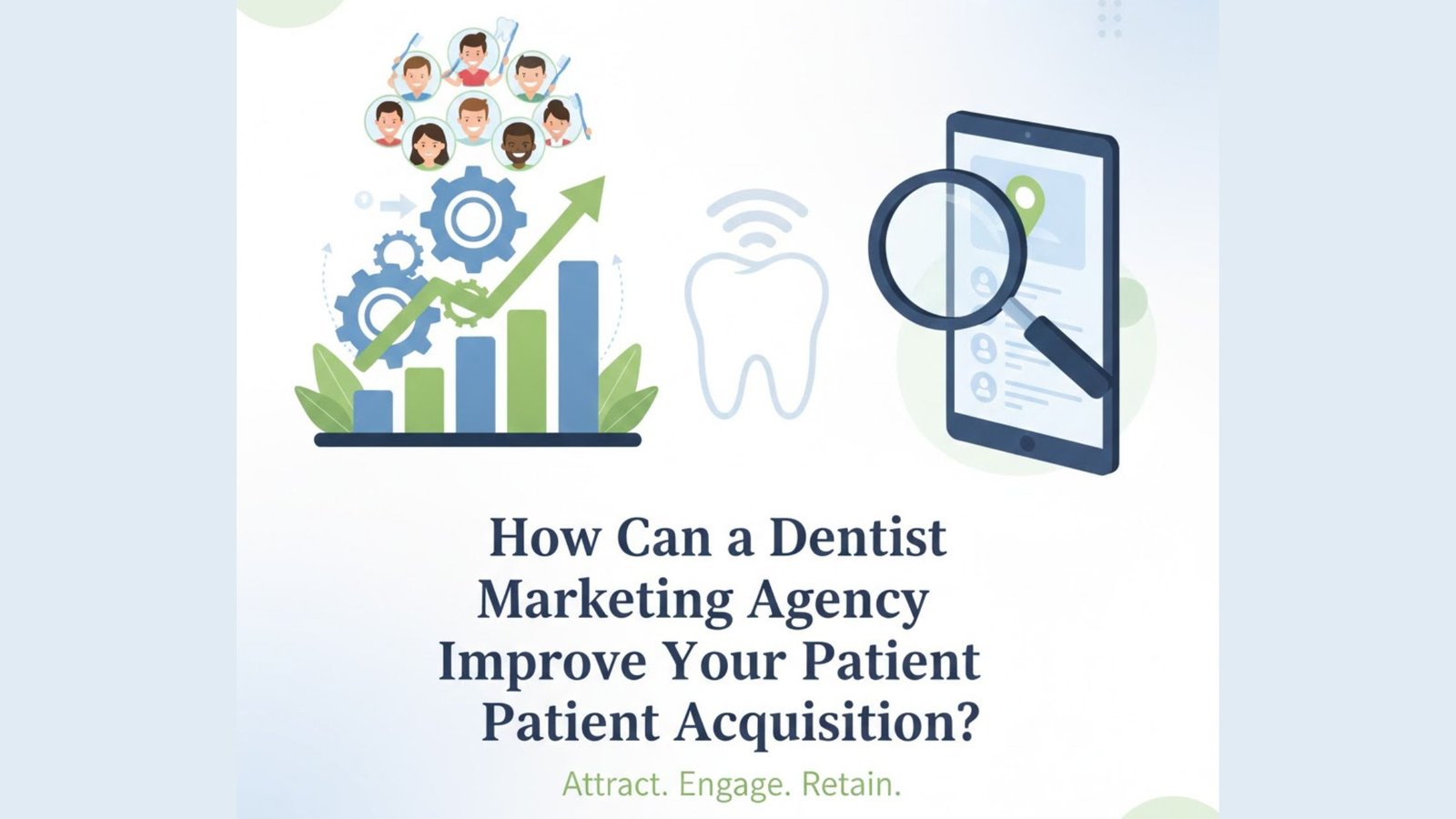
Imagine spending years building a dental practice with excellent clinical skills, a welcoming office, and a compassionate team, only to watch the appointment book stay half-empty while a competitor down the street seems to stay booked solid for weeks. That frustration is more common than most dentists realize, and the gap almost always comes down to one thing: how the two practices are marketing themselves online. A skilled dentist marketing agency does not just run ads or post on social media. It builds a complete patient acquisition system that works around the clock, capturing patients who are actively searching for care and converting them into scheduled appointments before a competitor can respond. In 2026, the practices that grow predictably are the ones that have stopped leaving patient acquisition to chance and started treating it as a structured, data-driven process.
What Does a Dentist Marketing Agency Actually Do for Patient Acquisition?
A dental marketing agency operates as a specialized growth partner for dental practices, handling every layer of the patient acquisition process that most practice owners simply do not have the time or expertise to manage themselves. Patient acquisition for dental practices involves far more than placing a Google Ad or updating a Facebook page. It requires a coordinated system where your online visibility, website experience, reputation, and follow-up process all work together to move a stranger from their first online search to a confirmed appointment in your chair. Each of those touchpoints needs to be carefully engineered to reduce drop-off and build trust at every stage of the patient journey.
Modern dental practices cannot rely on word-of-mouth referrals alone to sustain growth. Research shows that over 97% of US households turn to the internet when searching for service providers, including dentists. Patients compare multiple practices online before making a decision, reading reviews, visiting websites, and looking at social proof before ever picking up the phone. Without a strong and consistent digital presence powered by dental patient acquisition strategies, your practice becomes invisible to a massive pool of local patients who are actively looking for exactly what you offer. A specialized agency understands this landscape and knows how to position your practice where patients are already searching.
How Does Local SEO Drive Consistent New Patient Inquiries?
Local SEO is the most foundational element of dental patient acquisition strategies in 2026. When a potential patient searches “dentist near me” or “emergency dentist in [city name],” Google evaluates hundreds of signals to determine which practices appear in the Google Maps local pack and organic search results. The practices that appear in the top three positions of the Google Maps pack receive roughly 70% of all clicks in local searches, meaning the vast majority of online patients never scroll past those first few results. A dentist marketing agency with local SEO expertise ensures your practice is consistently positioned within those top spots.
Achieving strong local SEO rankings requires a fully optimized Google Business Profile (GBP), consistent NAP data (Name, Address, Phone number) across all online directories, locally targeted service pages on your website, and a steady flow of fresh patient reviews. It also requires geo-specific content that signals to Google exactly which neighborhoods and communities your practice serves. When all of these elements are aligned and maintained consistently, local SEO becomes one of the most cost-efficient patient acquisition channels available, generating inbound inquiries that compound in volume over time rather than stopping the moment an ad budget runs out.
The Role of Google Business Profile Optimization
Your Google Business Profile is often the very first impression a potential patient has of your practice. A complete, active, and well-optimized profile with accurate hours, service categories, procedure-specific attributes, high-quality photos, and regular post updates significantly increases both your visibility and your click-through rate from local search results. Agencies that manage GBP optimization understand the nuances of which categories to select, how to structure service descriptions with relevant search terms, and how to use the Q&A and product features to answer common patient questions directly within the search results. These details collectively send strong relevance and authority signals to Google, improving your ranking in the local pack.
Why Paid Search Advertising Fills Appointment Slots Faster
Organic SEO is a long-term investment, and while its results compound beautifully over time, a dental practice that needs new patients today cannot wait six to twelve months for rankings to build. This is precisely where pay-per-click advertising and Google Local Services Ads (LSAs) become critical tools in a broader patient acquisition strategy. Pay-per-click campaigns for high-intent dental keywords like “dental implants near me,” “emergency dentist open now,” or “Invisalign consultation” can begin generating patient calls within 48 hours of going live. The cost per click for dental keywords typically ranges from $3 to $25 depending on the service type and geographic market, making campaign structure and keyword targeting critical to maintaining a positive return on investment.
Local Services Ads represent an even more powerful tool for patient acquisition in competitive markets. LSAs appear above standard Google Ads and carry a “Google Guaranteed” badge, which signals verified credibility to prospective patients who are still evaluating their options. Because practices pay per lead rather than per click with LSAs, the model is highly cost-efficient for high-value procedures. An experienced dental marketing agency manages bidding strategies, ad copy testing, landing page optimization, and negative keyword lists to ensure your paid budget is producing actual booked appointments, not just unqualified website visits.
How Reputation Management Converts Interest Into Booked Appointments
Online reputation is one of the most powerful yet underestimated drivers of patient acquisition in dentistry. Over 86% of patients read online reviews before choosing a dentist, and most will not seriously consider a practice with fewer than 40 to 50 reviews or an average rating below 4.0 stars on Google. The challenge most practice owners face is not a lack of satisfied patients; it is a lack of a systematic process for turning that satisfaction into published reviews. Marketing for dental practices that truly accelerates acquisition includes an automated review generation system that requests feedback from patients at the optimal moment, typically within a few hours of their appointment when the positive experience is freshest.
Reputation management goes beyond generating reviews. A strong agency will also monitor your reviews across platforms including Google, Yelp, Healthgrades, and Facebook, and will manage professional responses to every review, both positive and negative. Potential patients do not only read your ratings; they read how your practice responds to criticism. A thoughtful, empathetic response to a negative review can actually strengthen trust with prospective patients who are watching how your team handles difficult situations. Practices that actively manage their online reputation consistently outperform those that leave it unattended, both in local search rankings and in conversion rates from online searches to scheduled appointments.
The Impact of a High-Converting Dental Website on Patient Volume
Your dental website is the central hub of every patient acquisition effort your practice makes. Every ad campaign, every social media post, every SEO ranking ultimately drives potential patients to your website, where they make the decision to contact you or click away to a competitor. A poorly designed, slow, or confusing website can undo all the work invested in driving traffic to it. Research consistently shows that websites optimized for patient conversion can increase appointment bookings by nearly 30% compared to sites that are simply designed to look professional without being engineered to guide behavior.
A high-performing dental website in 2026 must load in under three seconds on mobile devices, feature clear calls to action like “Book an Appointment” or “Request a Free Consultation” prominently on every page, and present trust signals like doctor bios, patient testimonials, before and after photo galleries, and recognized certifications immediately above the fold. It must also include dedicated landing pages for each core service, from cosmetic dentistry and teeth whitening to dental implants and orthodontics, with content structured to answer the specific questions patients are asking before they call. This level of conversion architecture does not happen by accident; it is the result of deliberate website design and user experience strategy that a skilled dental marketing agency applies to every client site.
If your practice is ready to take an honest look at where your current patient acquisition process is falling short, contact us to get a clear picture of where your biggest opportunities are hiding and how a structured approach could close the gaps.
Content Marketing and Authority Building for Long-Term Patient Flow
Marketing for dental practices that produces compounding results over time is built on content authority. When patients have a dental concern, their first instinct is to search for answers online. They type questions like “how much do dental implants cost,” “what is the difference between a crown and a veneer,” or “is Invisalign worth it for adults” into Google and AI-powered search tools. If your practice has published clear, helpful, well-structured answers to these questions on your website through blog posts, FAQ pages, and educational videos, you capture that search traffic and position your practice as the trusted expert before a patient even knows they are ready to book an appointment.
Content marketing in the dental space is closely tied to the concept of E-E-A-T, which stands for Experience, Expertise, Authority, and Trust. Google’s ranking systems in 2026 increasingly reward healthcare content that demonstrates real clinical experience, verified credentials, and genuine patient-centered education. An agency that specializes in dental content creates blogs and pages that target the specific questions your ideal patients are asking, naturally integrating semantically related entities like oral hygiene, periodontal health, cosmetic dentistry, restorative procedures, and preventive care throughout each piece. Over a twelve to eighteen month period, this content investment creates a growing library of search-visible assets that generate qualified patient traffic independent of any paid advertising budget.
Lead Generation for Dentists: Turning Clicks Into Confirmed Appointments
Getting patients to find your practice online is only half of the lead generation equation. What happens after a potential patient visits your website, fills out a contact form, or calls your front desk is just as critical as getting them there in the first place. Studies show that the likelihood of converting a new patient inquiry drops dramatically if your practice does not respond within the first five to ten minutes of that inquiry coming in. In a world where patients submit a contact form and then immediately search for the next option, speed-to-lead has become one of the highest-leverage variables in dental practice growth.
Lead generation for dentists goes beyond capturing contact information. It requires a follow-up system that is immediate, personal, and persistent. A dental marketing agency that understands conversion will implement automated text and email responses that engage the patient within minutes of their inquiry, confirm availability for their requested appointment type, and make it simple to complete the booking through an online scheduling tool. Practices that combine strong top-of-funnel visibility with an intelligent follow-up workflow can convert a significantly higher percentage of their incoming inquiries without generating a single additional lead.
Social Media and Video Content: Building Trust Before the First Visit
Social media marketing for dental practices in 2026 plays a different role than many practice owners expect. Patients do not typically go to Instagram or Facebook to find a dentist in the way they use Google. Instead, they use social platforms to evaluate and develop a sense of familiarity with practices they have already discovered through search. When a potential patient views your practice’s social media profile after finding you in Google, what they see either reinforces or undermines the trust that your website and reviews have begun to build. A consistent, engaging, and authentic social presence makes your practice feel human and approachable rather than clinical and transactional.
Video content is particularly powerful for dental practice marketing because it removes fear and builds personal connection before a patient ever steps inside your office. A short video tour of your treatment rooms, a welcome message from the dentist on camera, or brief procedural explainer clips like “what to expect during your first dental implant consultation” address the anxiety that keeps many patients from booking appointments with unfamiliar practices. An agency experienced in dental video content understands how to guide dentists through authentic on-camera communication that feels genuine rather than scripted, translating warmth and expertise into a format that converts curious online visitors into confident appointment-bookers.
How to Measure Whether Your Patient Acquisition Strategy Is Working
Investing in marketing for dental practices without clear performance measurement is one of the most common and expensive mistakes dental practice owners make. Vanity metrics like total website visits, social media followers, or ad impressions tell you very little about whether your marketing investment is actually translating into new patients and practice revenue. The metrics that matter are tied directly to patient behavior: how many new patient inquiries were generated this month, what percentage of those inquiries converted to scheduled appointments, what is the average cost per new patient acquisition across each channel, and how does the lifetime value of those patients compared to the cost of acquiring them.
A strong dental marketing agency will provide you with transparent, regular reporting that maps each marketing activity to actual patient outcomes. For context, a general dentistry patient typically carries a lifetime value of $1,500 to $3,000, while a cosmetic or implant case patient often represents $5,000 to $30,000 in lifetime production. Understanding these numbers transforms the conversation around marketing spend from a cost discussion to an investment return discussion. When you know that a $200 patient acquisition cost delivers a patient with a $15,000 lifetime value, the case for sustained marketing investment becomes immediately clear.
Key Patient Acquisition Channels Compared
The table below outlines the primary marketing channels a dental marketing agency manages and what each one delivers in terms of speed, cost, and long-term impact on patient flow.
| Marketing Channel | Time to Results | Cost Efficiency | Best For |
| Local SEO and GBP | 3 to 6 months | High long-term ROI | Ongoing organic patient flow |
| Google Ads (PPC) | 24 to 72 hours | Moderate, requires optimization | High-intent procedure searches |
| Local Services Ads | 48 hours | Pay-per-lead model | Verified credibility and fast wins |
| Reputation Management | 30 to 90 days | Very high | Trust-building and local ranking |
| Content Marketing | 6 to 18 months | Highest long-term ROI | Authority and compounding visibility |
| Social Media Marketing | Ongoing | Low to moderate | Brand familiarity and trust |
| Email and Follow-up Automation | Immediate | Very high | Lead conversion and patient retention |
Building a Patient Retention System Alongside Acquisition
Patient acquisition is only part of the growth equation for a dental practice. The average dental practice loses approximately 17% of its active patient base every year through natural attrition: patients who move, change insurance, switch providers, or simply lapse in care. For a practice with 1,500 active patients, that means replacing 250 or more patients every year just to stay flat. A comprehensive patient growth strategy addresses both the incoming flow of new patients and the ongoing engagement of existing ones through email marketing, appointment reminder sequences, reactivation campaigns for lapsed patients, and referral program systems that turn satisfied patients into advocates.
When a dental marketing agency builds a retention layer alongside your acquisition strategy, the compound effect on practice revenue is significant. Retained patients generate higher lifetime value, accept more comprehensive treatment plans, refer family and friends more frequently, and contribute disproportionately to your review count and reputation score. A practice that grows its active patient base while simultaneously reducing attrition is on a trajectory toward predictable, self-reinforcing revenue growth that becomes increasingly resilient to competition over time.
Once your acquisition and retention systems are working together, growth stops feeling reactive and starts feeling like a process you control. Reaching out through this page is the first step toward understanding what a fully integrated patient growth system could look like for your specific practice, your market, and your goals.
Frequently Asked Questions About Dental Patient Acquisition
How quickly can a dental marketing agency start generating new patients?
The timeline depends on which strategies are activated first. Pay-per-click campaigns and Local Services Ads can generate patient inquiries within 48 to 72 hours of launching. Reputation management improvements typically show measurable results within 30 to 90 days. Local SEO and content marketing build progressively over three to twelve months but deliver increasingly cost-efficient patient flow over time. A full-service agency will combine short-term paid channels with long-term organic strategies to create both immediate and compounding results simultaneously.
What is a realistic cost per new patient acquisition for a dental practice?
The cost per new patient varies by procedure type, geographic market, and competition density. General dentistry patient acquisition typically costs between $150 and $350 per new patient. High-value procedures like cosmetic dentistry, dental implants, or Invisalign often carry acquisition costs of $250 to $500 per patient, but these are offset by significantly higher lifetime patient value, sometimes ranging from $5,000 to $30,000 per case. Tracking acquisition cost relative to patient lifetime value is the most accurate way to evaluate the efficiency of any marketing channel.
How important are online reviews to dental patient acquisition?
Online reviews are one of the single most important factors in both local search rankings and patient decision-making. Over 86% of patients read reviews before choosing a dentist, and most patients will not book with a practice that has fewer than 40 reviews or an average below 4.0 stars. A consistent, automated review generation process maintained by a dental marketing agency can dramatically improve both your local visibility and your conversion rate from searcher to booked patient within 60 to 90 days.
Should a dental practice use both SEO and paid advertising, or is one enough?
Both serve different but complementary roles. Paid advertising delivers immediate patient inquiries while SEO is building momentum. Once organic rankings stabilize, typically after 6 to 12 months, the cost per patient acquisition from SEO drops significantly below paid channels and continues improving over time. The most successful dental practices invest in both simultaneously, using paid ads for fast wins and immediate cash flow while organic SEO and content marketing build a long-term, self-sustaining patient acquisition engine.
Can a dental marketing agency help with patient retention, not just acquiring new patients?
Yes, and the strongest agencies build retention systems alongside acquisition strategies. Retention tools include automated appointment reminders, post-visit follow-up sequences, email newsletters with oral health education and practice updates, and reactivation campaigns targeting patients who have not visited in six months or more. Because retaining an existing patient costs significantly less than acquiring a new one, a strategy that addresses both sides of practice growth consistently delivers better overall ROI than one focused purely on new patient generation.
Conclusion: A System-Driven Approach to Dental Practice Growth
Patient acquisition for dental practices in 2026 is not a matter of running a few ads or posting on Instagram and hoping the phone rings. It is a structured, multi-channel, data-driven system that requires deep expertise in local search, paid advertising, website conversion, reputation management, content authority, and patient follow-up automation. Every one of these elements needs to work together in a coordinated way to create a pipeline of new patients that is consistent, predictable, and scalable rather than scattered and reactive. The right dentist marketing agency does not sell you disconnected services; it engineers a full growth engine tailored to your market, your patient goals, and your practice’s specific strengths.
That is exactly the model at the heart of Tajaret’s approach to dental and service-based business growth. Tajaret’s integrated systems are purpose-built to help practices move from unpredictable inquiry spikes to a steady, compounding pipeline of qualified patient opportunities. By combining growth acceleration with decision acceleration, Tajaret helps practices become the visible, trusted, and obvious choice in their local market. If your practice is ready to stop chasing patients and start building a system that brings them to you, Tajaret is the partner designed to make that happen.


0 Comments